


DECANTER


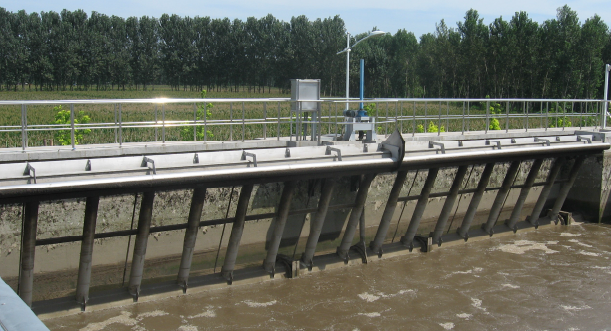
CMRD Model Rotary Decanter
Advantage
• Drainage is effective with a four-link drive
• Underwater support is stable, major risks are stopped and energy consumption is low
• Unique structure achieves flexible drainage
• Unique scum-clean water separation device, can avoid scum flow into the outlet pipe
• Underwater support is stable, major risks are stopped and energy consumption is low
• Unique structure achieves flexible drainage
• Unique scum-clean water separation device, can avoid scum flow into the outlet pipe
Application
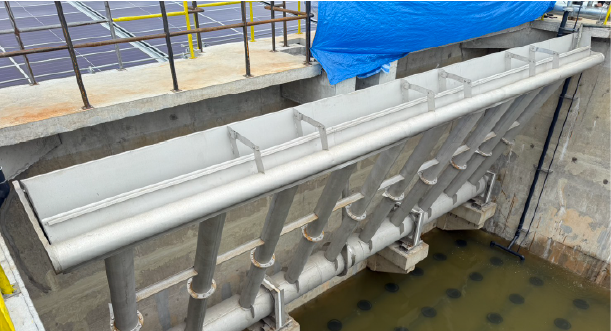
Decanter is the key equipment of SBR (sequencing batch reactor activated sludge
process) and CASS. The clean supernatant is removed from the basin using a decanter
assembly complete in stainless steel construction. During decanting there is no inflow
to the basin. The moving weir DECANT- ER is motor driven and travels slowly from its
“park” position to a desig- nated bottom water level. Once the decanting phase sets
in, the decanter automatically lowers to the required bottom level. Variable frequency
drives are provided to control the rate of movement of the Decanters. After the required
level of supernatant is removed the Decanter is returned to its “park” position through
reversal of the drive. The basin is now ready for the next cycle to begin.
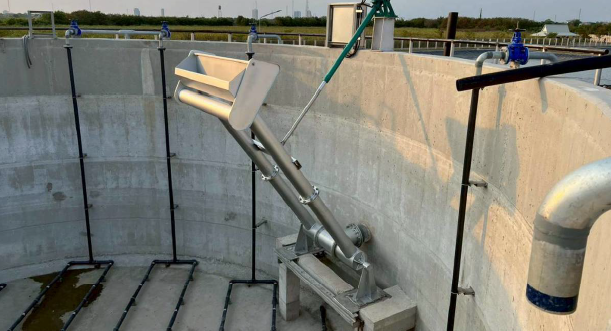
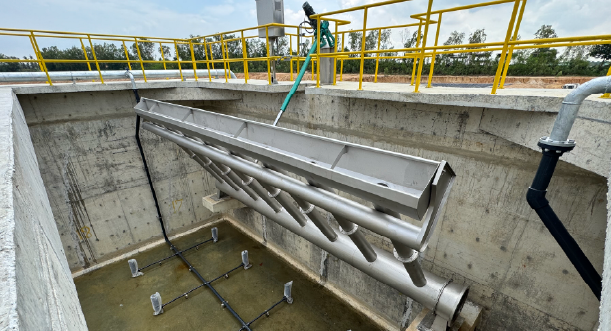
PS Model Rotary Decantor
Application
The PS-type rotating decanter is widely applicable to the treatment of urban sewage
and various industrial wastewaters such as those from papermaking, beer brewing,
tanning, and pharmaceutical industries. It is used to decant the treated supernatant
from the surface during the drainage stage and is a key equipment in the SBR
process.
Principle
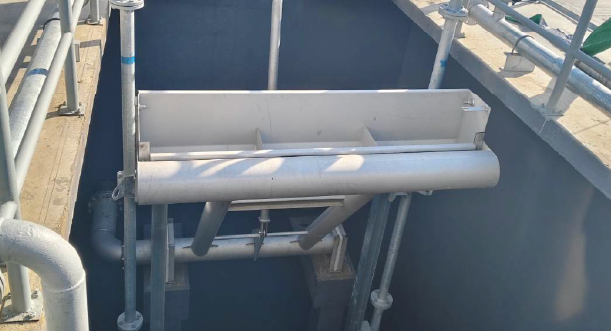
This equipment adopts a rotating and electric push rod design, and is installed in
the reaction tank or sedimentation tank. During operation, the drive device actuates
the push rod, causing the water to gradually drop to the water surface at a certain
speed (within the specified stroke range), so that the weir mouth is submerged under
the water surface. The supernatant flows in from the weir
mouth, is collected into the main pipe through the
water collection branch pipes, and then discharged. When
stopping, the push rod also lifts the decanting water seal,
making the weir mouth rise above the water surface, thus
completing a decanting process.
Advantage
The equipment has a compact structure, runs stably,
features convenient overall structure installation and low
operating cost. It has strong adaptability to changes in water
quality and quantity, and the water depth can reach 3.0m.
For a treatment capacity of Q < 1000 m /h, a single push rod
is adopted; for Q > 1000 m3/h, a double push rod is used.
A scum baffle is installed outside the decanting weir to
ensure that the liquid level at the weir does not fluctuate
during the operation of the equipment, thus ensuring the
effluent quality reaches the optimal level. The equipment is
equipped with frequency conversion speed regulation, PLC
automatic control and remote control, making operation and
management convenient.